
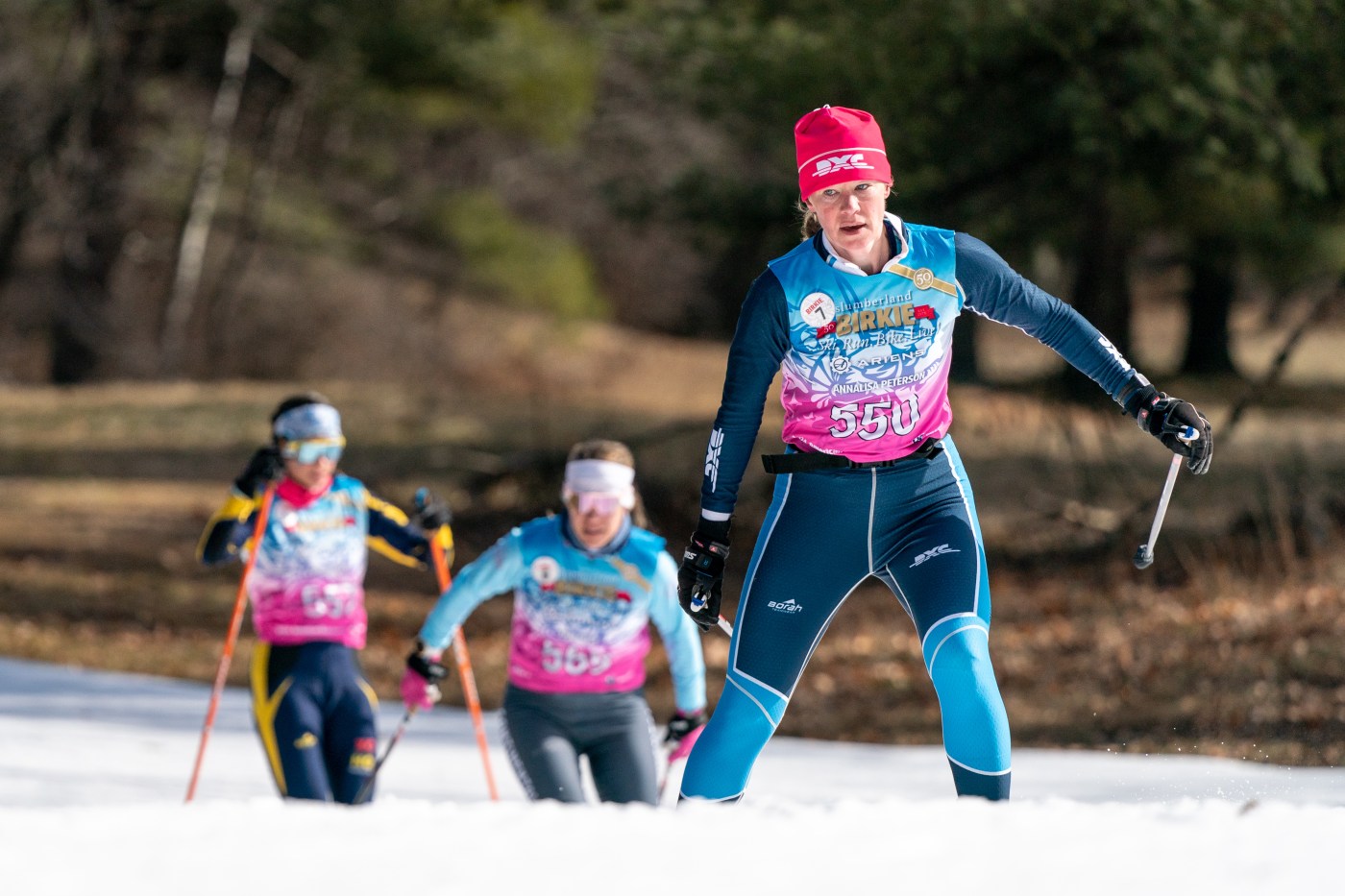
Annalisa Harrington Peterson was a cross country skiing standout at Duluth East High School in the late-1990s and Dartmouth College in the early-2000s. She rediscovered cross country skiing when she moved from California back to her hometown of Duluth, Minnesota, about 10 years ago. After returning to Duluth, Annalisa soon became a leader in the Duluth cross country ski community. She served as the chair of Duluth XC — a nonprofit aimed at promoting cross country skiing in Duluth — from 2016 to 2018.
This year, Annalisa completed her 7th American Birkibeiner ski marathon or “Birkie”. She has skied in the elite wave for all but her first Birkie and has placed as high as 17th. When not skiing, Annalisa works as a mediator for John Hopkins University and takes care of her two young kids Sigrid (age 10) and Astrid (age 7).
In this conversation, we talked about balancing motherhood and long-distance ski racing and how to make cross country skiing more inclusive. Annalisa also shares a funny story about the moment she realized that girls were just as capable of racing 10ks as boys.
This year, you completed your seventh American Birkibeiner ski marathon. What draws you to the ski marathon distance, rather than to shorter distance racing?
The shorter races are fun too! But, maybe they’re a younger person’s game? I have lost some of my speed over time.
I like the longer events because I enjoy the experience of letting the race unfold and covering some ground. It is really fun to ski hard — but not 5k hard! — for a long period of time. I enjoy the speed and glide and effort of skiing as well as the journey of a different race story every time I complete a ski marathon. That’s fun to me.
I also really love the community aspect of ski marathons. It still floors me that so many people will show up in the cold, ready to ski 50k.
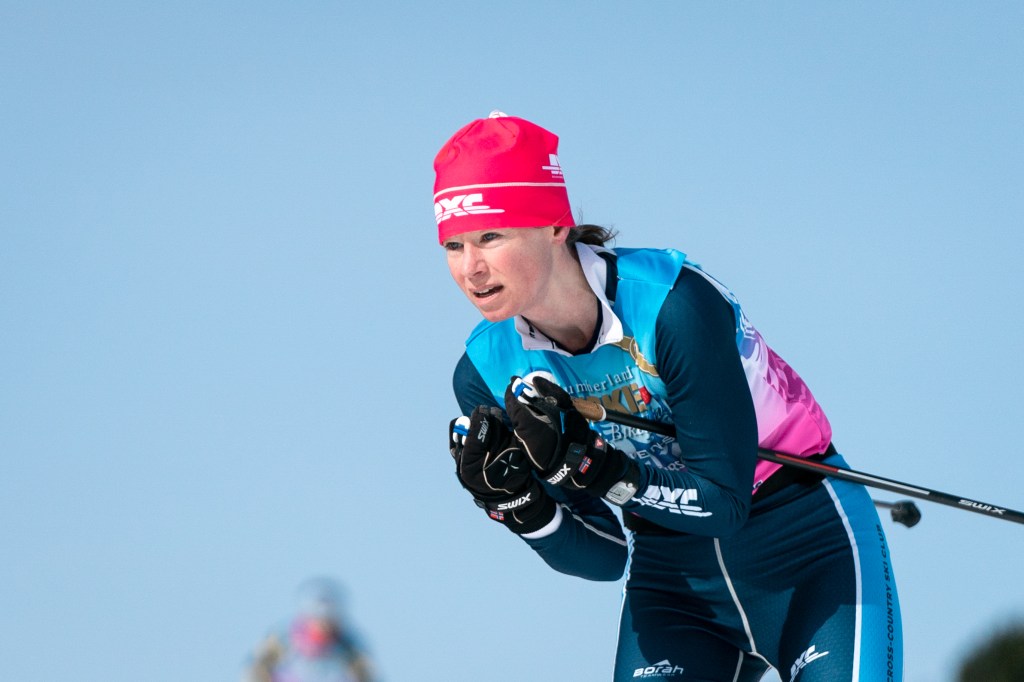
You skied at Dartmouth from 1998 through 2002. At that time, the NCAA had women racing shorter distances than men. In 2022, the NCAA finally decided to have women and men race the same distances. What message does the NCAA’s new equal distance race policy send?
The adoption of equal distance ski races for men and women is long overdue and signifies what we all already knew was true: Women are in no way less capable of engaging in endurance events than men. In fact, the longer the event, the less the separation there is between men’s and women’s fields.
I also participated in high school sports, where race distances were also different for both nordic skiing and running. I always thought it was the dumbest thing. We all rolled our eyes about it.
My first 10k ski race happened by accident. In a high school race, I was the first skier to come around the girls’ 5k loop course, and the course officials mistakenly sent me back around. By the time my oxygen-deprived brain realized I was doing a second loop, it was too late to turn back around. I finished the second loop in nearly the same time it took me to do the first loop and realized how much longer I could push myself than I had previously thought — whoops! It made me realize just how ridiculous it was that the status quo system was based on the notion that girls somehow couldn’t handle 10k distances, but boys could.
It made me realize just how ridiculous it was that the status quo system was based on the notion that girls somehow couldn’t handle 10k distances, but boys could.
I know you have two kids. How old are they?
I am the very lucky mama to Sigrid, age 10, and Astri, age 7. They are easily the coolest, weirdest and most hilarious people I know.
What value does training for and racing ski marathons provide that makes it worth taking some time away from parenting?
I love being a mom. I am also still an individual person with interests and passions and things I’m invested in. Skiing and running and just being an active person have been an important part of who I am for as far back as I can remember.
Moving my body outside helps me with my mental health, too. As a pretty introverted person, I really crave time alone. I don’t think of it as taking time away from parenting, but rather striving to be a whole and healthy person — which is something I really hope my kids will do too as they grow up.
I am very lucky that my spouse and I have been able to support one another so that we can both get out and enjoy things like sliding on snow — even when our kids were babies and I was particularly in demand as a mom. I am in constant admiration and awe of my friends who are solo parenting yet still find a way to make it all happen — heroes.
As my kids get older, I think they see and understand that skiing and running bring me joy and are part of what makes me me. I encourage my kids to figure out what those activities are for them as well.

You served as the board chair for Duluth XC, a nonprofit aimed at promoting cross country skiing in Duluth, Minnesota, for 3 years. What are your best ideas for making nordic skiing more inclusive?
If a person did not grow up cross country skiing, this sport we love is not exactly an approachable one, is it? The gear is expensive. The technique is not intuitive. Cold weather requires the right clothing. The cross country skiing landscape is not very diverse, being made up mostly of white folks.
I think making cross country skiing more inclusive is a long game that requires those of us who love it and are already “here” to be aware of the current realities and invested in shifting that over time.
Part of that shift involves creating opportunities for kiddos to try skiing by improving access to learn-to-ski programs through scholarships and gear availability. The University of Minnesota Duluth’s Recreational Sports Outdoor Program offers a gear and curriculum library that allows eligible groups to use equipment like skis free of charge. Some local schools are getting kids out on skis.
For adults, ski clubs like Duluth XC offering beginner ski lessons and prioritizing increasing access is important. As individuals, taking friends and acquaintances new to the sport out on the trails to try skiing is important.
None of this will solve the current challenges overnight. However, I think we all have the responsibility to be welcoming as individuals and participate in broader efforts to make cross country skiing more inclusive.
I don’t think of it as taking time away from parenting, but rather striving to be a whole and healthy person — which is something I really hope my kids will do too as they grow up.
What are the biggest challenges and opportunities for getting more women involved with nordic skiing?
Looking back, so much has changed for the better for women in sports even just since my mom was a child in the 50s and 60s. I had many more opportunities to participate in sport than she did. Furthermore, since I joined the Duluth East High School ski team in 1993, the number of girls participating has exploded. From what I understand, high school participant numbers are pretty equal between student skiers who identify as girls and boys.
Yet, if you go to almost any citizen ski race, you’ll find that men significantly outnumber women. I think some of this goes back to our culture’s ongoing lopsidedness around parenting. Women who become parents often take on a disproportionate amount of parenting duties, meaning they don’t always have time for activities like skiing. For the amazing moms out there who are solo parenting, getting out to ski requires the additional cost and logistics of childcare coverage. For those who didn’t grow up skiing, it can be really intimidating and cost prohibitive to pick it up as an adult.
Along with beginner ski lessons, there are some awesome women-specific events happening. DXC, COGGS, Continental and Ski Hut [local nonprofit organizations and outdoor gear stores] have partnered in recent years to offer “Women’s Night” events for cross country skiing and fat biking throughout the winter. This is an awesome way to encourage women to enjoy these activities with a welcoming community of other women.
The American Birkibeiner Foundation has recently started offering the “Ski de She” camp and race in January “for women to come together to expand their skills, build race confidence, and connect with fellow women skiers.” I think events like these are on point as ways to encourage more women to get on the trails and experience the joy of sliding on snow.
Annalisa recommends:
“Why is the US Nordic Skiing Community so White?” by Ben Theyerl. (2020). FasterSkier.com. https://fasterskier.com/2020/08/why-is-the-us-nordic-skiing-community-so-white/
Black Faces, White Spaces by Dr. Carolyn Finney (2014) UNC Press Books.

 Onward
Leave a comment